

The average BMX rider goes through three pumps before finding one that actually works reliably — wasting $60–$120 on pumps with inaccurate gauges, heads that leak air during inflation, or barrels too small to fill 2.4-inch tires without exhausting your arms. A BMX tire pump needs to handle specific demands that general-purpose bike pumps often fail at: Schrader valve compatibility without adapters, gauge accuracy in the 40–100 PSI range where BMX tires operate, and enough air volume per stroke to fill high-volume tires efficiently. Buying the wrong pump means inconsistent tire pressure, frustrating pre-ride routines, and eventually a pump collecting dust while you borrow someone else’s.
A BMX tire pump is a floor pump or portable pump specifically compatible with Schrader valves (standard on BMX wheels), equipped with a gauge accurate within ±2 PSI in the 30–110 PSI range, and designed with sufficient barrel volume to inflate 20-inch BMX tires (1.75″–2.4″ width) from flat to riding pressure within 30–50 strokes.
This guide identifies exactly which pump features matter for BMX, which are marketing fluff, and how to evaluate reliable bike pump reviews to avoid the most common purchasing mistakes BMX riders make.
What Are the Most Common BMX Tire Pump Buying Mistakes?
The three most common mistakes: buying a road-bike-focused pump with poor Schrader compatibility, choosing based on maximum PSI rating rather than gauge accuracy at BMX operating pressures, and ignoring barrel volume which determines how many strokes it takes to fill a BMX tire.
Mistakes ranked by frustration level:
- Presta-first pump head design: Many popular pumps prioritize Presta valve fitting with Schrader as an adapter or secondary position. This causes air leakage, difficult attachment, and valve core damage on BMX Schrader valves.
- Inaccurate gauge in BMX range: Pumps rated to 160 PSI often have gauges optimized for accuracy at 80–120 PSI (road bike territory). At 40–70 PSI where most BMX tires operate, these gauges can be off by 5–8 PSI — meaningless readings.
- Small barrel volume: Road and hybrid bike pumps use narrow barrels (low volume per stroke) optimized for high-pressure, low-volume tires. BMX tires are high-volume — a narrow barrel means 80–120 strokes from flat vs. 30–50 with an appropriate pump.
- Cheap hose connections: Budget pumps use push-on hose fittings that develop leaks within months. Threading or quick-release metallic connections last years longer.
- No bleed valve: Without a precision air release button, you can’t reduce over-inflation by small amounts — you must detach the head (losing 2–3 PSI) and reattach to check. Wastes time and air.
What Features Actually Matter in a BMX Floor Pump?
Three features matter most: a Schrader-native pump head that seals without leaking, a gauge accurate within ±2 PSI at 40–80 PSI, and a barrel diameter of 30mm+ for efficient high-volume tire inflation. Everything else — color, brand logo, maximum PSI rating — is secondary.
| Feature | Why It Matters for BMX | What to Look For |
|---|---|---|
| Pump Head Type | Schrader valve seal quality determines if air actually enters the tire or leaks | Twin-head or auto-switching head with strong Schrader chuck. No adapters needed. |
| Gauge Accuracy | BMX operates at 40–100 PSI where many gauges are least accurate | Gauge rated accurate ±2 PSI. Large dial (2.5″+ diameter) readable without squinting. |
| Barrel Diameter | Determines air volume per stroke — bigger = fewer strokes to fill BMX tires | 30mm+ barrel. High-volume mode if dual-stage pump. Should fill 2.4″ tire from flat in under 50 strokes. |
| Hose Length | BMX bikes sit low — short hoses force awkward pump positioning | Minimum 24-inch hose. Flexible rubber preferred over stiff plastic. |
| Base Stability | High-volume pumping generates lateral force that tips narrow-base pumps | Wide steel base or T-shaped footplate that stays planted during aggressive strokes. |
| Build Material | BMX riders pump hard and frequently — plastic internals fail within a year | Steel or aluminum barrel. Metal pump head internals. Replaceable seals. |
How Do You Tell If a Pump Gauge Is Accurate for BMX Pressures?
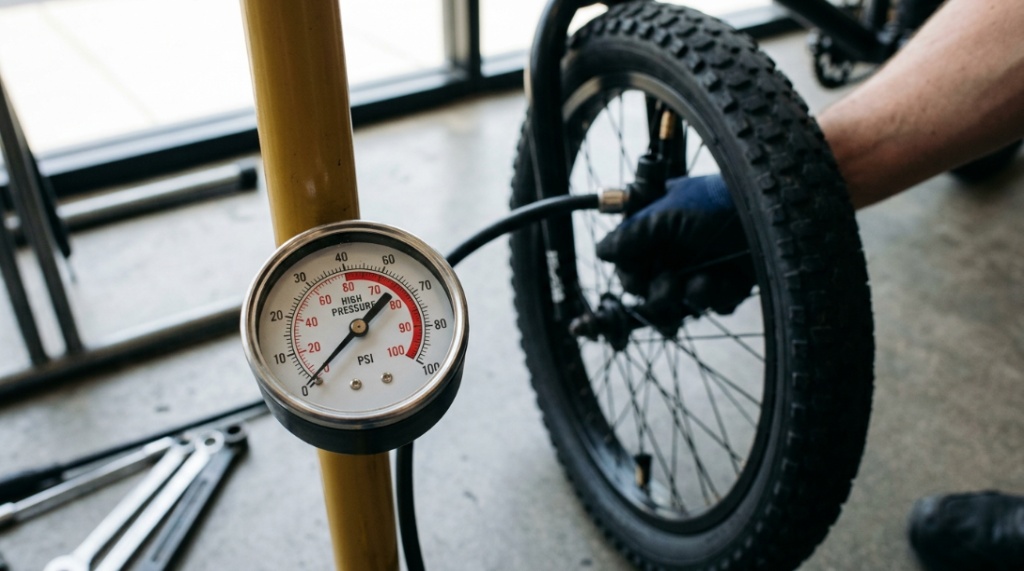
Test the pump gauge against a standalone digital pressure gauge ($10–$15). Inflate a tire to 60 PSI on the pump gauge, then check with the digital gauge. If they differ by more than 3 PSI, the pump gauge is unreliable for BMX pressure management.
Gauge accuracy testing method:
- Step 1: Inflate tire to exactly 50 PSI according to pump gauge
- Step 2: Remove pump head carefully (minimal air loss with quality heads)
- Step 3: Immediately check pressure with standalone digital gauge
- Step 4: Repeat at 70 PSI and 90 PSI to check linearity
- Step 5: If readings differ by more than ±3 PSI at any point, the pump gauge is unreliable
Common findings: budget pumps under $25 typically show 4–8 PSI inaccuracy in the BMX operating range. Mid-range pumps ($35–$60) from reputable brands usually stay within ±2 PSI. This accuracy difference matters because 5 PSI affects BMX handling noticeably.
For pumps tested and verified accurate in BMX pressure ranges, the top-rated BMX bike pump reviews include gauge accuracy testing data from real-world use.
Should BMX Riders Use Floor Pumps or Portable Pumps?
Floor pumps should be your primary inflation tool — they’re faster, more accurate, and easier on your arms. Portable pumps serve as emergency backups only. Never rely on a mini pump as your primary BMX tire inflation solution — the small barrel volume makes full inflation from flat nearly impossible without extreme effort.
Use case breakdown:
- Floor pump (primary — home/garage): Full-size barrel fills BMX tires in 30–50 strokes. Accurate gauge for precise pressure setting. Stable base for two-handed operation. Used daily or pre-ride.
- Portable frame pump (emergency backup): Straps to frame or fits in a bag. Handles mid-ride flats after tube repair. Requires 150–200+ strokes from flat — arm-exhausting but functional. Inaccurate gauge if any.
- CO2 inflator (fastest emergency option): Fills a BMX tire in seconds from a single cartridge. No physical effort. But single-use cartridges cost $3–$5 each, and you can’t fine-tune pressure. Carry as emergency only.
The winning combination for BMX riders: a quality floor pump at home for daily pressure maintenance, plus one CO2 inflator with a spare cartridge in your backpack for skatepark or trail emergencies.
How Much Should You Spend on a Reliable BMX Tire Pump?
Spend $40–$70 for a floor pump that delivers accurate gauges, durable construction, and reliable Schrader compatibility for 3–5+ years of daily BMX use. Below $30, gauge accuracy and seal durability suffer noticeably. Above $80, you’re paying for aesthetics or features BMX riders don’t need.
Price-to-quality tiers:
- Under $20: Plastic construction, inaccurate gauges (5–10 PSI off), poor hose seals. Will need replacement within 6–12 months of regular use. Frustration generator.
- $20–$35: Mixed quality. Some decent pumps exist here but gauge accuracy is inconsistent. Acceptable as a first pump or backup.
- $40–$70: Sweet spot for BMX riders. Metal barrels, accurate gauges, quality pump heads, replaceable seals. Brands like Lezyne, Topeak, Bontrager, and Blackburn dominate this range. Lasts 3–5 years of daily use.
- $70–$120: Premium materials (carbon fiber barrel, CNC machined parts) and ultra-precise gauges. Beautiful but the functional improvement over the $50 tier is marginal for BMX applications.
The true cost of a cheap pump isn’t the $20 purchase price — it’s the inconsistent pressure readings that cause flats, the leaked air that makes pre-ride pumping take twice as long, and the replacement cost when it fails within a year.
What Pump Head Design Works Best for BMX Schrader Valves?
A twin-head design with a dedicated Schrader opening (not a reversible internal mechanism) provides the most reliable seal and easiest attachment for BMX valves. Avoid pumps requiring you to flip an internal gasket or use adapter sleeves — these wear out and leak.
Pump head types ranked for BMX use:
- Best: Twin-head (separate Schrader and Presta openings): Dedicated Schrader chuck sized perfectly for the valve. No adapters, no internal switching. Push on, lock, pump. Example: Topeak JoeBlow series.
- Good: Auto-switching smart head: Internal mechanism detects valve type automatically. Works well when new but the switching mechanism can wear over time. Example: Lezyne floor pumps.
- Acceptable: Threaded Schrader chuck: Screws onto valve for a guaranteed seal. Slower to attach/remove but zero leak potential. Preferred by riders who hate pump-head air loss.
- Avoid: Adapter-required designs: Presta-native heads with screw-on Schrader adapters. Adapters add a failure point, get lost, and never seal as well as native Schrader chucks.
How Do You Know When It’s Time to Replace a BMX Tire Pump?
Replace your pump when the gauge reads more than 5 PSI different from a reference gauge, when the pump head leaks air audibly during inflation despite being locked, or when you notice the handle requires significantly more force than when new (indicating internal seal failure).
Replacement indicators:
- Gauge drift: When cross-checking reveals 5+ PSI inaccuracy that wasn’t present when the pump was new
- Audible head leakage: Hissing from the pump head connection during strokes despite proper attachment
- Increasing stroke resistance: Pumping feels harder than it used to at the same target pressure — internal barrel seal is worn
- Hose cracking: Visible splits or softening in the hose that create slow leaks or sudden failures
- Base instability: Footplate welds or rivets loosening, causing the pump to wobble dangerously during use
Before replacing entirely: check if replacement seals and gaskets are available for your pump model. Quality pumps from Lezyne, Topeak, and Bontrager sell replacement seal kits ($5–$10) that restore pump performance for another 2–3 years.
Maintaining correct tire pressure ensures smooth landings and protects your rims from harsh pinch flats, but tire care is only half the battle when it comes to keeping your ride rolling smoothly. Just as a low-pressure pump makes inflation a chore, a dry, gritty drivetrain will rapidly sap your momentum and ruin your components. To ensure your power transfers perfectly to the dirt or pavement, pairing your fresh tire setup with a high-quality Mountain Bike Chain Lube will keep your link movement quiet, friction-free, and fully protected against grit and moisture.
What About Electric/Digital BMX Tire Pumps?
Portable electric pumps (like the Ryobi or Makita cordless inflators) work for BMX but are overkill for daily use. They excel at traveling to remote spots or filling tires after trail flatting where hand-pumping isn’t practical. They’re not replacing your floor pump for daily pressure maintenance.
Electric pump considerations for BMX:
- Pros: Effortless inflation, digital pressure setting (auto-shutoff at target PSI), works great for filling tires from completely flat without arm fatigue
- Cons: Battery dependent, slower than a quality floor pump for topping off a few PSI, more expensive ($50–$100), and another device to charge
- Best use case: Riders who drive to distant skateparks or trails and want effortless tire management away from home
For garage/home use, a manual floor pump remains faster and more reliable — no batteries to die, no motor to fail, and instant readiness.
Conclusion
Avoiding the wrong BMX tire pump means prioritizing three things: native Schrader valve compatibility without adapters, gauge accuracy within ±2 PSI at your operating pressure range, and sufficient barrel volume to fill high-volume BMX tires efficiently. Spend $40–$70 on a quality floor pump from an established brand, verify gauge accuracy with a standalone digital gauge, and your pre-ride inflation routine becomes a 60-second habit instead of a frustrating battle with leaking heads and unreliable readings.
Ready to pick a pump that won’t let you down? The top-rated BMX bike pump guide reviews current models with BMX-specific testing for gauge accuracy, Schrader compatibility, and inflation efficiency.
What pump are you using now and what drove you to buy it? Share your experience in the comments — reliable bike pump reviews from actual BMX riders are worth more than any spec sheet.
Frequently Asked Questions
Do BMX bikes use Presta or Schrader valves?
Most BMX bikes use Schrader valves — the same wider valve type found on car tires. Schrader is standard on BMX because it’s more durable against impacts, easier to inflate at gas stations in emergencies, and doesn’t require a lock-nut that can loosen during aggressive riding. Some high-end race BMX wheels use Presta for weight savings.
Can I use a gas station air pump for my BMX tires?
Yes, in emergencies — gas station compressors work with Schrader valves. But use extreme caution: gas station pumps deliver high volume fast and have inaccurate gauges. BMX tires can over-inflate and blow off the rim within seconds. Add air in 1–2 second bursts and check with your own gauge between additions.
How many pump strokes does it take to fill a BMX tire from flat?
With a standard floor pump (30mm barrel), expect 35–50 strokes to fill a 20″ x 2.3″ BMX tire from flat to 65 PSI. High-volume pumps with larger barrels do it in 25–35 strokes. Mini portable pumps require 150–200+ strokes — that’s why they’re emergency-only tools.
Why does my pump lose air when I disconnect from the valve?
All pumps release a small burst of air (1–2 PSI) when the head disconnects from a Schrader valve — this is the air trapped in the hose and head mechanism escaping. Quality pumps minimize this to under 1 PSI. If you’re losing 3+ PSI on disconnection, your pump head’s internal check valve is failing and needs replacement.
Is a dual-stage pump worth it for BMX?
Dual-stage pumps switch between high-volume (fast fill) and high-pressure (precise top-off) modes. For BMX street and park riders (40–85 PSI), they’re convenient but not essential. For BMX race tires (100–120 PSI), dual-stage makes high-pressure inflation significantly easier on your arms.
How long should a quality BMX floor pump last?
A quality floor pump ($40–$70 range) should last 3–5 years of daily use with occasional seal replacement. Premium pumps ($60+) with all-metal construction and replaceable parts can last 7–10+ years. The barrel and frame rarely fail — it’s always seals, gaskets, and hose connections that wear first.



+ There are no comments
Add yours