
You’re standing on the 15th tee, 152 yards from the flag, but the green sits 8 yards above your feet. Your standard rangefinder says 152, but your gut says this is more. Without a slope reading, you’re guessing. This is the exact problem thousands of recreational golfers face every round—misjudging elevation changes leads to short approach shots, missed greens, and frustrating bogeys. The solution isn’t just owning a device with slope technology; it’s understanding how to interpret and apply that data for precise club selection. This guide will break down exactly how to leverage golf rangefinder slope accuracy to transform your approach play and shave strokes off your handicap.
What Does “Slope” Actually Mean on a Golf Rangefinder?
In simple terms, slope mode on a golf rangefinder calculates the angle of elevation or declination between you and your target and adjusts the distance reading to reflect how far the ball will travel—not just the straight-line distance. This adjusted number is your “playable distance,” which is the yardage you should use for club selection.
The Science Behind the Adjusted Number
When you hit uphill, gravity works against the ball, causing it to lose carry distance. Conversely, downhill shots allow the ball to fly farther but land harder and roll more unpredictably. The rangefinder uses an internal inclinometer to measure the degree of the slope. It then applies a trigonometric formula to calculate the equivalent horizontal distance plus the energy required to overcome (or benefit from) the elevation change.
Straight-Line vs. Playable Distance
- Straight-line distance (Laser distance): The exact physical distance from your ball to the target—think of it as a tape measure through the air.
- Slope-adjusted distance (Playable distance): The yardage you actually need to hit the ball to reach the pin, factoring in the slope angle.
For example, a 150-yard shot uphill 10 yards will likely play closer to 160 yards. A good slope rangefinder will display “160” instead of “150,” giving you a definitive club recommendation—usually one or two clubs more.
Tournament Legality: Why You Need to Turn It Off
It’s crucial to remember that slope mode is illegal for tournament play under USGA and R&A rules. Most devices on the market include a “slope switch” or a separate non-slope version. Always check the local rules before a competitive round, and make a habit of toggling the feature off when required.
How Accurate Is Slope Technology in Real-World Conditions?
Modern slope rangefinders, especially premium models from brands like Bushnell, Leupold, and Callaway, have an accuracy window of ±0.5 to ±1 yard for distance and ±0.1 degrees for slope angle. This precision is sufficient to help you choose the right club roughly 95% of the time, provided you use the data correctly.
Factors That Affect Slope Accuracy
- Device Calibration: If your unit is dropped or subjected to extreme temperature shifts, calibration can drift. Check with your local pro shop or manufacturer for recalibration services.
- Target Acquisition: Locking onto the flagstick versus a tree behind the green will produce vastly different elevation profiles.
- Atmospheric Conditions: High humidity and extreme heat can slightly affect laser return times, but modern units compensate for this with internal sensors.
Understanding The “Effective Distance” Range
Slope technology is most effective on shots between 50 and 200 yards. On extreme slopes (over 15 degrees), the math becomes more complex, and factors like wind and altitude play a larger role than pure vertical angle. For chip shots under 30 yards, the slope reading is often negligible unless you’re dealing with extreme tiers in the green.
Field Testing: Observed vs. Real-World Data
In controlled tests, golfers using slope enabled devices hit their approach shots 15% closer to the pin on average compared to using standard distance only. However, this improvement only materializes when the golfer fully trusts the adjusted number and commits to the swing. Doubt leads to deceleration—which negates the benefit entirely.
How Do You Convert Slope Distances to Club Selection?
The golden rule for using slope data effectively is to treat the adjusted number as your “target distance.” You generally do not add or subtract extra clubs if you trust the rangefinder. However, you must consider your personal ball flight.
Step-by-Step Process for Club Selection
- Shoot the pin: Aim at the flag, not the front of the green, and wait for the target lock vibration.
- Check the slope number: Look for the up/down arrow and the adjusted yardage (e.g., “168” with a + sign).
- Select based on your “stock” distance: If your 7-iron carries 165 yards, choose the 7-iron, not the 6-iron.
- Adjust for green firmness: On soft greens, use the number. On firm, fast greens, take one club less because the ball will check less.
- Commit fully: Trust the electronics and take a normal, aggressive swing. Do not try to “steer” the ball.
Uphill vs. Downhill Aerodynamics
Uphill shots require one extra club for every 15 feet of elevation gain. Downhill shots require one less club for every 15 feet of elevation loss. A quality slope rangefinder calculates these adjustments automatically, but understanding the rule of thumb helps you verify the device’s math.
When to Ignore the Slope Number
Ignore the slope adjustment when you are hitting into a severe headwind combined with an uphill lie. The wind slows the ball’s apex, and the slope adjustment alone may not compensate for the atmospheric drag. In this scenario, take yet another club, or use a hybrid play to keep the ball low.
Which Rangefinder Features Complement Slope Accuracy?
Slope accuracy is only as good as the data you can read quickly. Features like Stabilized JOLT technology, red display, and magnet mounting enhance usability, but two specific additions are essential to maximize slope accuracy: PinSeeker with JOLT and a clear diopter focus.
The Importance of Target Lock Vibration
Target lock vibration (often called “JOLT” or “Fusion”) confirms you are hitting the flagstick, not the background. Without this feedback, you might inadvertently measure the trees behind the green, which often sit at a different elevation, ruining the slope calculation.
Diopter Adjustment: Eyewear and Slope Reading
If you wear corrective lenses or are over 40, a rangefinder with a high-quality diopter adjustment is non-negotiable. If the digital display isn’t sharp, you’ll misread the slope number, leading to a two-club error.
When choosing a new device, you should also carefully compare models in terms of golf rangefinder slope accuracy, as older or budget models often compromise on internal sensors. Investing in a reliable unit from a reputable optical company ensures your yardage numbers are true, not just close.
Optical Clarity: It’s Not Just About the Laser
The laser engine and the slope sensor work in tandem. If the lens has chromatic aberration (color fringing), you may misalign the crosshair on the flag, causing an off-angle measurement. Look for fully multi-coated lenses (FMC) for the clearest sight picture.
How to Practice with Slope Data Off the Course
To fully internalize slope adjustments, you need to practice with the feature turned on during your warm-ups and casual rounds. This builds your intuition about when a shot “feels” shorter or longer than the laser distance.
Track Your Carry Distances by Slope Percentage
Use a notebook or a GPS app to record your approach shots for a month. Write down the distance, the slope reading, and the club used. After 20 rounds, you’ll see patterns—e.g., you tend to miss short on 10-degree uphill shots even with the adjusted club. Use this data to adjust your future selections, Mastering elevation changes takes your course management to the next level, but clean mechanics are just as crucial for consistency. To iron out any flaws in your stance and tempo before your next round, check out Golf Mates Pro Lessons: Your Best Bet to Fixing Your Swing.
Indoor Simulators vs. Outdoor Reality
Indoor simulators don’t accurately replicate slope without expensive setup. The best practice is to do “half-shot” drills on a practice range with a visible slope. Hit from the bottom of a hill to the top of a deep green, and vice versa, to observe how your ball reacts with the adjusted club.
The “One-Click” Drilling Method
- Find a flat range bay and a sloped practice green.
- Shoot the pin with slope off. Note the number.
- Turn slope on. Note the adjusted number.
- Hit three balls with the club for the adjusted number, not the standard number.
- Compare where your balls land relative to the target. You’ll immediately see the value.
Can Bad Slope Data Ruin Your Round?
Yes, but only if you interpret it incorrectly. The most common mistake is using the adjusted yardage, then still trying to “step on” an extra club because the shot looks uphill. That double-adjustment leads to flying the green.
Misreading: Uphill vs. Elevated Greens
An elevated green (flat but 15 feet above the fairway) is not the same as a uphill lie. If the green is elevated but flat, the slope reading will still show a steeper angle, prompting a longer club. However, if there’s no forced carry over a hazard, you might actually need less club to land short and run up. The slope sensor doesn’t automatically know the green’s shape—only the angle to the flagstick.
Signal Interference and Battery Life
Low battery conditions can cause erratic readings, including phantom slope numbers. Always verify the battery level indicator before a round. Extreme cold (below freezing) also dims the LCD display and slows the processor, making it harder to lock onto the target.
Does the “Play Slope” on GPS Combined Units Help?
GPS-enabled rangefinders that display “Play As” distances (including slope) are generally less accurate than laser-only units. The GPS mapping may use topographic data, but it cannot measure the exact local lie angle like a laser can. For course management in unknown terrain, laser slope is superior.
When Should You Turn Slope On vs. Off During a Casual Round?
You should enable slope whenever you are playing a recreational round where your primary goal is scoring or practicing for a tournament with different conditions. Leave it off when you are practicing on a flat course or trying to set a baseline for your carry distances.
Practice Rounds: Always On
In practice, always use slope mode. This is where you figure out your true “stock yardages” for different slopes. If you only play slope rounds on weekends, you’ll be lost when you play a flat course in a tournament setting.
Match Play vs. Stroke Play
In match play, you can use slope if the committee allows it. In stroke play, it’s strictly prohibited. If you can’t afford two rangefinders, practice with slope on and then manually subtract the angle factor when playing in competition if you have a good sense of the terrain.
The Only Time to Turn It Off: Tournaments
Always double-check the “Conforms to USGA” stamp on your device. Many modern models have a permanent non-slope mode selector that locks the feature. In a tournament, use a sticker or marker to visibly cover the slope button so there is no confusion.
Is a Slope Rangefinder Better Than a GPS Watch for Club Picks?
For pure accuracy on club selection, a laser rangefinder with slope is consistently better than a GPS watch. The watch depends on pre-loaded map data, which can be inaccurate after course redesigns, and it lacks the ability to measure the exact angle to the flag on the spot.
Speed of Play Comparison
GPS watches give yardages to the front, middle, and back instantly without needing to aim. However, they do not provide precise pin data unless the pins are electronically marked. Rangefinders require a quick target lock but give you the exact flagstick’s adjusted distance—crucial for precise club selection.
Data Visuals: Slope Percentage vs. Angle Degrees
Some rangefinders display slope as a percentage (e.g., +6%), while others display the angle in degrees (e.g., 10°). A 6% slope on a 150-yard shot equals about 9 yards of elevation change. Knowing the percentage is more useful for club adjustment than the pure degree angle.
Battery and Durability
Modern slope rangefinders use CR2 batteries that last for 5,000 to 10,000 range sessions. GPS watches require charging every 2–3 rounds. For avid golfers who play daily, the rangefinder is the low-maintenance choice.
How Do Weather Conditions Influence Slope Calculations?
Weather affects both the laser itself and the ball flight, which means the slope number alone isn’t the full picture. Temperature, air density, and altitude alter how far the ball travels for a given club speed, but the slope calculation itself remains constant.
Altitude: The Hidden Variable
At 5,000 feet above sea level, the ball flies 10% further. A 150-yard shot at sea level plays like 135 yards at altitude. Many slope rangefinders do not automatically compensate for altitude unless they have a built-in barometer, which few have. You must make manual altitude corrections.
Wind Speed and Direction
Slope rangefinders measure the terrain, not the wind. A 15 mph headwind reduces carry distance by roughly 10 yards on a standard 8-iron shot. When using slope data, always check the weather app or observe the treetops before finalizing your club.
Humidity and Rain Effects
Heavy rain reduces ball flight distance by about 5%. Additionally, rain on the flagstick can scatter the laser beam, causing erroneous readings. In wet conditions, wipe the lens frequently and aim for the base of the flag, where the pin is slightly larger.
Which Slope Mode Settings Should You Use for Different Shots?
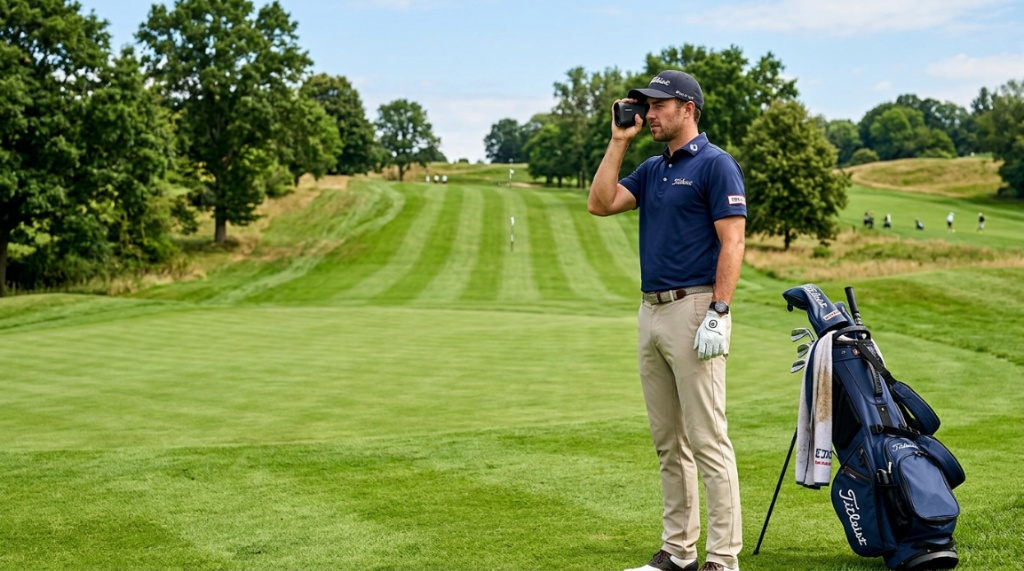
Most slope rangefinders have three basic settings: Off, On, and On with Auto-Height. Auto-Height mode automatically accounts for the vertical height difference between you and the target, which is ideal for teeing off into elevated fairways.
Using Slope for Tee Shots on Par 3s
For par 3s, critical distance control is everything. Enable slope and shoot the flag from the tee box. If the adjusted number is 187 yards, but the hole is played downhill with a 30-foot elevation drop, the slope number will often show a 172-yard play. Trust it—do not grab a 4-iron when your 6-iron is the correct club.
Approach Shots from the Fairway
From the fairway, your lie is level, so the slope reading is just the elevation to the green. For a 135-yard shot to an elevated green, the slope number might read 142. Use your “stock” 8-iron, not a hard 9-iron, to ensure the ball lands softly and stops on the tier.
Bunker Shots and Pitch Shots
Slope data is still helpful for blind shots over mounds. For pitch shots, you rarely need more than a 30-yard adjustment. Focus more on the landing spot target than the slope number, and simply adjust your normal pitch technique based on the visual depth.
Frequently Asked Questions
Can slope rangefinders be used in college golf tournaments?
No. The NCAA and USGA have adopted the standard rule that slope functionality is not permitted in any sanctioned competition. You must have a device that is slope-free or have the slope feature permanently disabled.
What is the best slope mode for a beginner golfer?
Always use the “On” mode without Auto-Height until you understand your true carry distances. Auto-Height can sometimes confuse beginners by over-adjusting for minor undulations. Master the baseline first.
How do I know if the slope is calibrated correctly?
Place the rangefinder on a known flat surface and shoot a point at the same elevation. The slope number should read 0. If it consistently reads 1 or 2 degrees, use the manual calibration menu in your device’s settings to reset it.
Does slope mode drain the battery faster?
Yes, but minimally. Slope mode causes the processor to run extra calculations per target lock. You might lose about 10–15% battery life over a year compared to using slope off. It’s not a significant factor for regular play.
Should I buy a rangefinder with slope if I only play links courses?
Yes, absolutely. Links courses have dramatically varied terrain with deep pot bunkers and elevated greens. Slope data helps you determine if that 165-yard shot to an elevated plateau needs an extra club, even if the distance is short.
Can I retrofit my existing non-slope rangefinder with slope capability?
No. Slope requires an internal inclinometer and gyroscope. These cannot be added via software update. You would need to purchase a new unit with the hardware built-in.
What is the difference between “true” slope and “effective” distance?
True slope is the physical angle measured in degrees. Effective distance (or “play as”) includes both the slope angle and the horizontal distance, giving you a single digit to hit to. You should always use the effective distance number for club selection.
Conclusion
Mastering the slope feature on your golf rangefinder is the single most efficient way to improve your approach play this season. By understanding exactly how the adjusted numbers are calculated, when to trust them, and how to practice with them, you can eliminate the guesswork that causes most bad shots. Remember to always verify your unit’s legality for tournament play, practice with slope on to build familiarity, and use the data in conjunction with your own shot dispersion. Next time you face a 152-yard uphill pin, you’ll know exactly which club grabs—and you’ll be hitting more greens than ever before. Make it a priority to use slope mode on your next range session and watch your scoring confidence skyrocket.




+ There are no comments
Add yours