
I once handed a riding buddy my bottle of dry chain lube before a wet-weather ride and watched him apply it perfectly — only to have his chain sound like a dying cat within 8 miles because the first stream crossing washed it completely off. Wrong lube for the conditions. The following week, he used wet lube on a bone-dry Sedona trail and came back with a chain so caked in red paste that the derailleur could barely push through it. Wrong lube again. Choosing between dry and wet mountain bike chain lube is not a preference — it is a conditions-based decision that determines whether your chain runs silently for 50 miles or screams for mercy after 10. A wet chain lube excels in rain, mud, and stream crossings where water displacement is essential. A dry lube dominates in dust, sand, and arid heat where particle resistance matters most. Using the wrong type for your conditions creates more drivetrain damage than using no lube at all. This guide explains exactly when to use each type, why they fail in the wrong conditions, and how to handle rides where conditions change mid-route.
What Is the Fundamental Difference Between Dry and Wet Chain Lube?
Dry lube uses a volatile carrier that evaporates after application, leaving a solid lubricating film (wax or PTFE) on chain surfaces. Wet lube remains in liquid oil form permanently, providing continuous fluid lubrication between metal surfaces — each approach trades one advantage for a different vulnerability.
Core mechanical differences:
| Property | Dry Lube | Wet Lube |
|---|---|---|
| State after application | Solid film (dry to touch) | Liquid film (oily to touch) |
| Dust attraction | Very low (particles cannot bond to dry surface) | Very high (sticky oil captures all particles) |
| Water resistance | Very low (washes off with water contact) | High (oil repels water, stays on chain) |
| Longevity (dry conditions) | 25–60 miles | 50–150 miles |
| Longevity (wet conditions) | 5–15 miles (washes off) | 30–80 miles |
| Cleaning difficulty | Easy (water or light solvent) | Harder (requires degreaser) |
| Drivetrain cleanliness | Very clean (no sticky residue) | Dirty (attracts and holds contamination) |
| Application technique | Requires drying time (15–240 min) | Immediate use after application |
| Best temperature range | 50–110°F | 20–90°F |
Neither type is universally better. Each solves a specific problem while creating a specific vulnerability. The correct choice depends entirely on your riding conditions — and many riders maintain both types for different situations.
When Should You Use Dry Chain Lube?
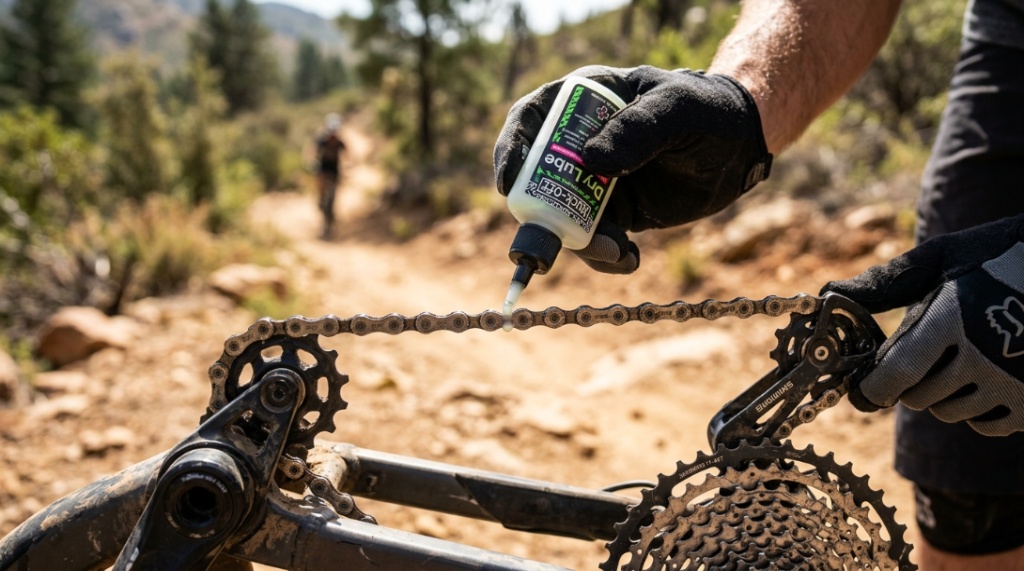
Use dry chain lube when riding in dusty, sandy, or arid conditions where airborne particles are the primary contamination threat — typically when humidity is below 50%, no rain is expected, and trails are composed of mineral-based surfaces (dirt, sand, rock).
Dry lube conditions:
- Desert and arid trails: Utah, Arizona, Nevada, Colorado front range — anywhere fine dust is the dominant contamination
- Summer riding: Hot, dry months when rain is unlikely and trails are dusty
- Sandy environments: Beach-adjacent trails, sandy washes, decomposed granite paths
- Fire roads and hardpack: Compacted surfaces that generate fine particulate when disturbed
- Indoor training: No contamination at all — dry lube keeps the trainer and floor clean
Why dry lube wins in these conditions:
- The solid film does not attract or hold dust particles
- Contamination that contacts the chain falls off rather than bonding
- Wax-based dry lubes self-clean: old wax flakes carry trapped dirt away
- The drivetrain stays clean throughout the ride, reducing overall wear
The key indicator: if your rides finish with a dry, dusty chain appearance (grey/brown powder on surfaces), dry lube is correct for your conditions.
When Should You Use Wet Chain Lube?
Use wet chain lube when riding in rain, mud, frequent stream crossings, or consistently humid environments (above 70% humidity) where water contact would strip dry lube from the chain within minutes — leaving metal unprotected in the most corrosive conditions.
Wet lube conditions:
- Rainy rides: Any time water will contact the chain during the ride
- Muddy trails: Pacific Northwest, UK trails, spring-thaw conditions
- Stream crossings: Trails with water features that submerge the drivetrain
- High humidity (70%+): Tropical, coastal, or consistently damp environments
- Winter riding: Snow, slush, road spray, and salt exposure
- Multi-day bikepacking: When weather is unpredictable and mid-ride application is difficult
Why wet lube wins in these conditions:
- Oil-based formula repels water — stays on the chain during rain and crossings
- Continuous liquid film prevents corrosion from moisture exposure
- Higher viscosity resists being washed away by flowing water
- Longer intervals between applications — critical when carry capacity is limited
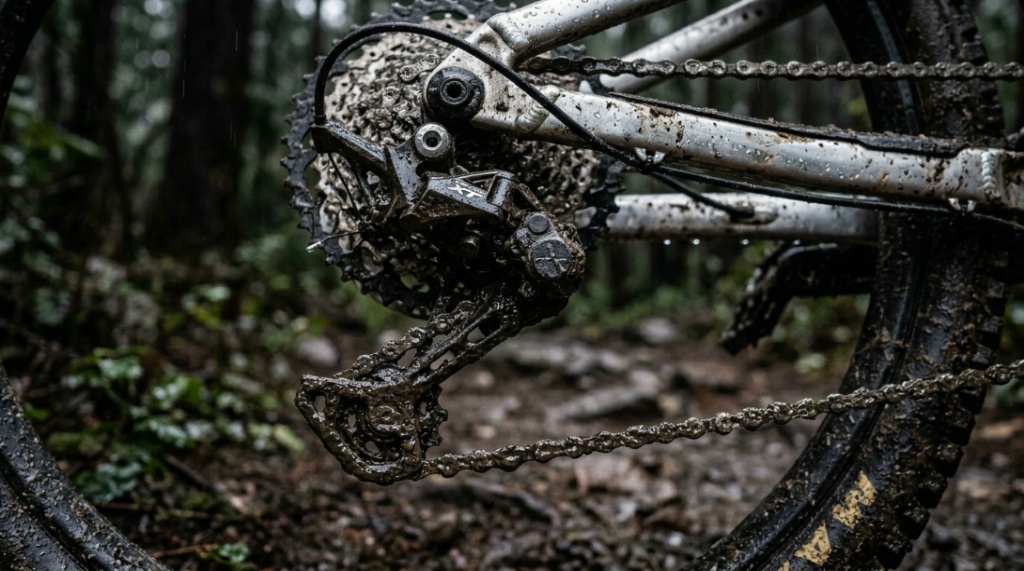
The key indicator: if your rides finish with a muddy, wet chain appearance (dark paste on surfaces), wet lube is correct — but you must clean thoroughly after every ride to remove the contamination it has trapped.
What Happens When You Use the Wrong Type?
Using dry lube in wet conditions leaves your chain unprotected within minutes of water contact, causing rapid corrosion and metal-on-metal wear. Using wet lube in dusty conditions creates an abrasive grinding paste that accelerates wear faster than having no lube at all.
Wrong-type consequences:
Dry lube in wet conditions:
- First water contact dissolves the wax/PTFE carrier — protection disappears
- Chain runs metal-on-metal with zero lubrication
- Water causes immediate surface corrosion on exposed steel
- Combination of friction + corrosion accelerates wear dramatically
- Sound: loud grinding/squeaking within 5–15 minutes of water exposure
Wet lube in dusty conditions:
- Sticky oil surface captures every dust particle that contacts the chain
- Dust + oil forms an abrasive paste (essentially liquid sandpaper)
- Paste grinds metal inside rollers with every pedal stroke
- Chain wear rate can EXCEED dry-chain wear rate because the paste is more abrasive than dry dust alone
- Appearance: thick black or brown paste coating entire drivetrain
The dusty-conditions scenario is counterintuitive: using wet lube actually causes MORE damage than using no lube in dust because the oil transforms loose dust (which would mostly fall off) into bonded abrasive paste (which stays and grinds). This is why dry lube is non-negotiable in dusty environments.
How Do You Handle Rides Where Conditions Change?
For rides that start dry and encounter water (or vice versa), apply dry lube as default for mixed conditions, carry a small wet lube bottle for emergency re-application if water strips your protection, and accept that no single product perfectly handles both extremes simultaneously.
Mixed-condition strategies:
- Primarily dry with brief water crossings: Use dry lube. Brief water contact (under 30 seconds) may not fully strip a quality wax lube. Reapply after if noise increases. Accept slightly reduced protection during the wet section.
- Primarily wet with dry sections: Use wet lube. The dust attraction during dry sections is acceptable when the alternative is no protection during wet sections. Clean thoroughly after the ride.
- 50/50 mixed conditions: Use a “all-conditions” hybrid lube (Rock N Roll Gold, Smoove Universal). These compromise between wet and dry performance, handling neither extreme perfectly but managing both adequately.
- Unpredictable conditions (bikepacking): Carry both types. Apply dry as default. Switch to wet if sustained rain develops. The weight penalty (3–4 oz total) is trivial compared to drivetrain replacement cost.
For comprehensive comparisons of dry versus wet chain lube performance in specific mountain biking environments, mountain bike chain lube comparisons in real conditions provides testing data that shows exactly how each type performs across varying dust and moisture levels — eliminating guesswork from your lube selection.
Can You Switch Between Dry and Wet Lube Seasonally?
Yes — seasonal switching is the optimal strategy for riders who experience distinct wet and dry seasons. However, switching requires a full chain degrease between types because wet lube residue prevents dry lube adhesion, and dry wax residue can clump when wet lube is applied over it.
Seasonal switching protocol:
- Dry season → Wet season transition:
- Full chain degrease (remove old wax/PTFE completely)
- Rinse and dry thoroughly
- Apply wet lube per product instructions
- No drying time needed — ride immediately
- Wet season → Dry season transition:
- Full chain degrease (remove all oil residue — this is critical)
- Multiple solvent passes may be needed to fully remove wet lube from inside rollers
- Verify chain is completely oil-free (passes white rag test)
- Apply dry lube and allow full drying time
- If any oil remains, dry lube will not adhere properly
The wet-to-dry transition is harder because oil-based products are more difficult to fully remove than wax-based products. Budget extra cleaning time when switching from wet to dry — residual oil causes dry lube failure within miles.
Proper gear maintenance isn’t just for the trails; taking care of your equipment transitions seamlessly into other sports, too. Just like choosing the right lubricant keeps your drivetrain smooth, finding the right tools for precision makes all the difference on the green. If you swap your bike helmet for a golf cap on the weekends, checking out a guide on the Best Blade Putters for Men can help sharpen your short game with that same dialed-in, mechanical accuracy.
Conclusion
The dry vs wet mountain bike chain lube decision is not about preference — it is about physics. Dry lube creates a non-stick surface that sheds dust in arid conditions. Wet lube creates a water-resistant film that protects during rain and mud. Using the wrong type for your conditions causes more damage than using no lube at all. Match your lube to your riding environment: dry for dust, wet for water, and a full degrease when switching between seasons.
Most mountain bikers benefit from keeping both types available. Dry lube handles 70–80% of fair-weather riding. Wet lube covers the remaining rainy days, winter rides, and mud seasons. A small investment in both products — plus the discipline to choose correctly each ride — protects thousands of dollars in drivetrain components across every season and condition you encounter on the trail.
Do you switch between dry and wet lube seasonally, or have you found one product that handles your local conditions year-round? Share your approach below.
Frequently Asked Questions
Can I use dry lube year-round?
Only if you ride exclusively in dry conditions and never encounter rain or significant water. Any water contact strips dry lube rapidly. If you experience even occasional wet rides, keep a small wet lube bottle as backup. Riders in consistently arid climates (Arizona, Nevada, parts of Colorado) can successfully use dry lube year-round.
Is wet lube bad for my chain?
Wet lube itself does not damage chains — it provides excellent lubrication. The problem is what it attracts: dust and dirt that become abrasive paste. In wet conditions (its intended use), water washes away contamination continuously, so the paste does not form. In dry conditions, the paste accumulates and causes accelerated wear. Wet lube is fine in wet conditions; problematic in dry ones.
What about “all-conditions” or “all-weather” lubes?
All-conditions lubes compromise between wet and dry performance — they resist water better than pure dry lubes and attract less dust than pure wet lubes. They work acceptably in moderate conditions but underperform dedicated products in extremes. Good for riders who face unpredictable mixed conditions and want one bottle. Not optimal for riders who consistently face either extreme dusty or extreme wet conditions.
How do I know if my chain needs wet or dry lube for today’s ride?
Simple decision tree: Will water contact your chain during this ride (rain, crossings, puddles)? If yes → wet lube. If no → dry lube. When uncertain, dry lube is the safer default for a single ride because you can always reapply if it washes off, but you cannot un-attract dust from wet lube once applied.
Does temperature affect which lube type to use?
Extreme cold (below 20°F) thickens wet lube, increasing viscosity and drag. Extreme heat (above 100°F) can thin wet lube excessively and accelerate dry lube evaporation. For cold-weather riding, choose a wet lube specifically formulated for low temperatures. For extreme heat, wax-based dry lubes resist temperature degradation better than PTFE-based ones.
Can I layer dry lube over wet lube or vice versa?
No — mixing types creates problems. Dry over wet: the wax cannot adhere to oily surfaces and slides off. Wet over dry: oil dissolves or clumps wax residue, creating an inconsistent surface. Always fully degrease between type changes. Within the same type (e.g., reapplying fresh dry lube over existing dry lube), layering works fine and is standard practice.
Which type lasts longer per application?
Wet lube lasts significantly longer per application (50–150 miles) versus dry lube (25–60 miles) because the liquid film continuously self-distributes while solid films wear away through use. However, wet lube’s longer interval comes with the cost of attracting contamination throughout that interval. The “effective protection” (considering contamination damage) often favors dry lube’s shorter but cleaner intervals in appropriate conditions.





+ There are no comments
Add yours